
Frequently Asked Questions
Whether you are familiar with engine pre-lube systems, or considering your first install, we've provided a comprehensive Q & A section. We firmly believe that the better educated the consumer is, the more likely it is they'll try to stump us with a question we haven't had.
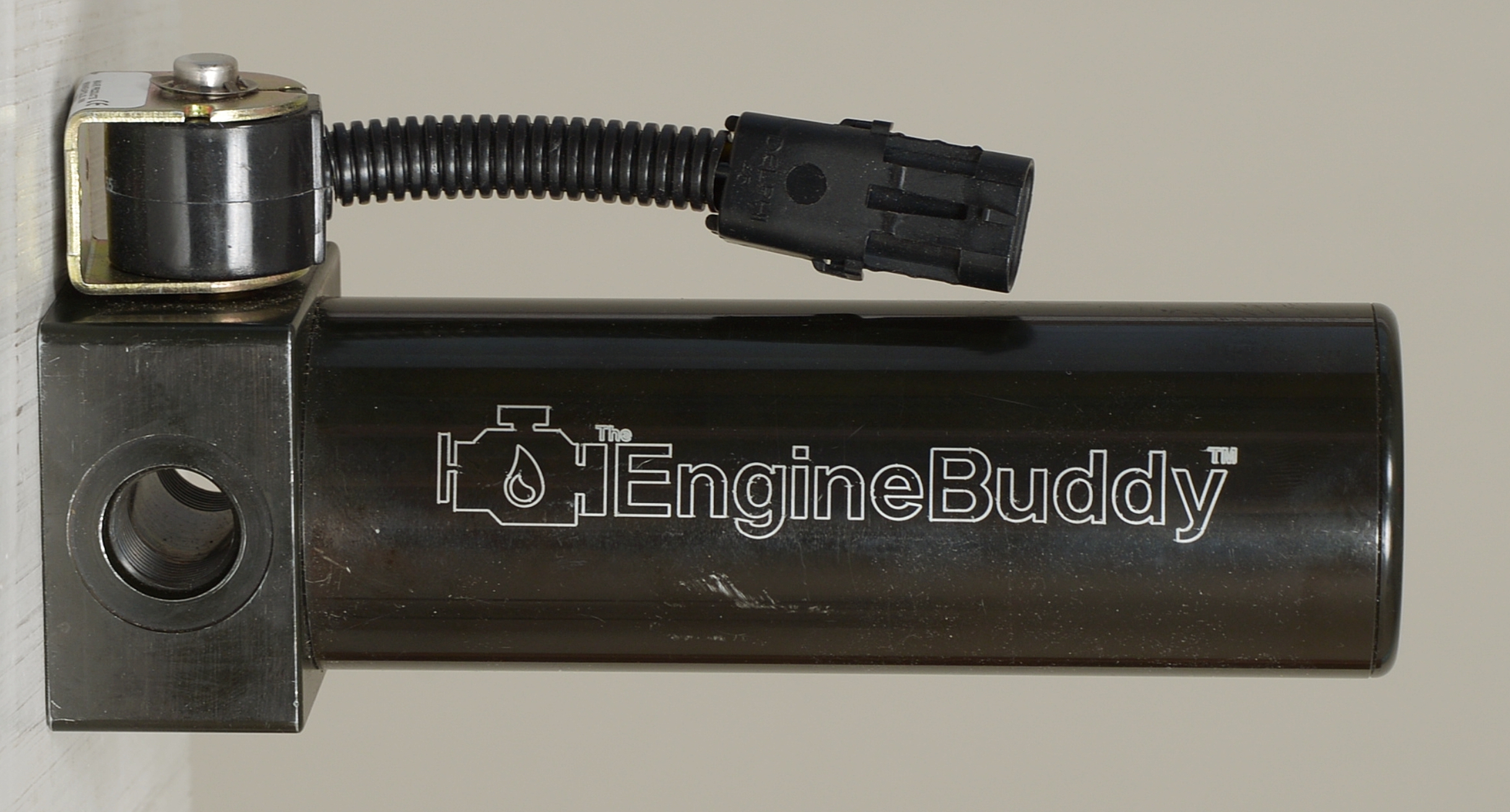
TheEngineBuddy™ - Q&A
A: A self-contained system constructed of anodized aluminum and carbon steel, and offering a life cycle that neutralizes over one million dry engine starts, theEngineBuddy™ is assembled from two main components, a robust engine oil reservoir cylinder and an engine compartment mounting base. TheEngineBuddy functions as an engine oil reservoir, holding oil and dispensing it under pressure when the vehicles ignition switch is turned on. This eliminate the wear that occurs during engine start-up.
When theEngineBuddy is electronically actuated prior to engine start-up (or when theEngineBuddy is manually switched on if installed with a toggle switch) an electrical signal triggers the solenoid mounted on theEngineBuddy to open a valve and discharge 160 cubic centimeters (9.7 cubic inches or 0.16 liter) of pressurized engine oil from theEngineBuddy oil reservoir to pre-lubricate critical engine components like bearings and other internal wear sensitive surfaces. By pre-lubricating the engine prior to initiating the engine crank-start cycle, dry start engine wear is dramatically reduced.
A directional flow check-valve allows theEngineBuddy reservoir to automatically refill/recharge directly from the vehicle's oil pump output in less than 40 seconds after engine start. This reverse pressure compresses the spring and piston housed in theEngineBuddy cylinder assembly, whereby the unit is recharged until activated again.
NOTE: For safety, an internal pressure relief valve maintains maximum EngineBuddy pressure below 60 PSI. The nominal discharge pressure of theEngineBuddy is 35 psi. Pressure is higher at first, but decreases through the length of theEngineBuddy piston discharge stroke. When fully retracted (compressed) the spring inside theEngineBuddy engine oil reservoir is ~100 psi. When fully extended after discharge the spring pressure is ~15 psi, which is why theEngineBuddy recharges itself off of normal engine oil pressure after the engine starts.
The elimination of dry engine starts is the main function of theEngineBuddy. It pre-charges your engine with 160 cc of motor oil prior to starting your engine providing unprecedented engine wear protection prior to starting your engine and for the first 2 minutes of engine operation. During cold weather operation, theEngineBuddy saves fuel and engine wear and tear during the engine's critical first 5 minutes of operation. In cold weather climates theEngineBuddy not only eliminates the need to run your engine during a lunch break or over-night, but saves on battery life because engines turn over much more easily.
Note: Not only is engine dry start a major engine wear issue, but so too are the first several minutes of engine operation. After starting the engine it can take from 2-5 minutes for the engine oil to reach operating temperature and the appropriate oil viscosity to circulate effectively to design specifications. This is when most engine wear occurs. Further, until the engine oil has reached operational temperature, the engine oil viscosity may be heavy enough that many oil filters may operate in partial or full filter by-pass mode. When this occurs - unfiltered engine oil may circulate through your engine. TheEngineBuddy provides critical engine wear risk mitigation by pumping engine oil between critical metal wear surfaces prior to engine start up.
A: Several independent studies* have concluded that most engine wear occurs during start up. Although this period is of short duration, it is a critical few moments that engine rotation is occurring without oil pressure … and without engine oil separating opposing metal surfaces. The EngineBuddy™ is designed to add to the protection already offered by the installed engine oil to “prevent dry starts”. The need for theEngineBuddy is apparent given the number of occasions that automotive, marine, commercial, and industrial /farm engines or equipment are subjected to frequent daily dry starts.
Equally detrimental are extended periods between use cycles which results in minimal oil film strength at engine start up. The net result if an engine starts dry is metal-to-metal contact of internally lubricated engine components and corresponding engine wear. Pre-oiling a vehicles engine with theEngineBuddy before starting an engine will minimize the wear associated with dry engine starts.
Engine Dry Start Time Example: Let’s assume that the elapsed time between when you turn the ignition key, and your engine runs with full film lubrication, is approximately 4 seconds. While this short 4-second interval does not seem like it would have much impact on the overall performance or life of your vehicles engine, what would you say if you were asked to take your personal vehicle, drain out the oil, and run down the highway for 1.5 hours without any engine oil?
Engine Wear - The Work Factor: There are 220 work days per year. If you work this means you must start/stop your car 2X per day to get to and from work. Assuming you only go out to lunch half of the time, and that you stop for a dine-in lunch, versus going through a drive-thru, you will have 2X additional start/stop cycles to the typical work day.
220 work days x 2 dry starts/day x 4 seconds/dry start = 1,760 seconds dry run time
= 29.3 minutes of dry engine run time annually for work
110 work day lunches x 2 dry starts/day x 4 seconds/dry start = 880 seconds dry run time
= 14.7 minutes of dry engine run time annually for lunch
Engine Wear – The Kid Factor: If you have kids, look out! Assume the almost impossible average of 2 events per child per week. For a 4-person family (two kids), this equates to another 27.7 minutes of dry start damage.
52 weeks x 2 kids x 2 events/week x 2 dry starts/event x 4 seconds/dry start = 1,664 seconds
= 27.7 minutes of dry engine run time annually for kid activities
Personal Factor: There is no telling how many dry starts can be attributed to going to the grocery store, cleaners, hardware store, Christmas/birthday/anniversary shopping, movies, out for dinner, vacation, etc. but it’s safe to assume that you average a minimum of three of these events occurring per week.
52 weeks x 3 events/week x 2 dry starts/event x 4 seconds/dry start = 1,248 seconds
= 20.8 minutes of dry engine run time annually for personal events
Total Vehicle Dry Engine Run Time Annually (conservative estimate): If you add up the minutes, as illustrated in this example, you will see that this vehicle is literally subjected to an approximate 1.5 hours of operation per year when it is running without engine oil to dry-start events
= 92.5 minutes … which correlates to 1.54 hours of engine dry run time per year.
While none of us would tempt fate by draining our engine oil and taking a 1.5 hour trip without any engine oil, now you know and understand why engines don’t last forever, and why you need theEngineBuddy. Based on your vehicles duty cycle, your estimated minutes of annual engine dry run time could be significantly higher.
A: The reason engine wear occurs at start-up is because the engine is cold. In the typical case when an engine is first started, it has zero or close to zero oil pressure, and must rely upon the residual engine oil on all its bearings and moving surfaces until it's been spun over and the oil pump builds pressure. Then the oil has a chance to circulate to the top of the engine and get splashed around to lubricate and protect critical metal surfaces. While this occurs, the potential for engine wear is at its highest.
Prior to a cold engine start the majority of the engine oil film has drained off the engine oil surfaces that require lubrication. Even engines that are engineered with an oil check valve to facilitate trapping engine oil in the upper parts of the engine will suffer from the oil drain phenomena. It only takes a small fraction of time for oil pressure to build and recoat all the wear surfaces, but during this time engine wear is occurring. The objective of the EngineBuddy™ is to deliver engine oil to critical mechanical surfaces BEFORE cold engine starts to minimize engine wear.
An engine whose oil has reached operating temperature can be shut off, and then restarted, with minimal engine wear. This is because the oil has not had adequate time to drain off of the engines lubricated surfaces. In other words, and as any credible engine engineer will tell you … warm/hot engine starts produce almost no wear because the engine is off for such a short amount of time the necessary engine oil film doesn't have time to drain off of metal surfaces and parts.
NOTE: It should be noted that when you shut off your engine, and it cools, the interior of the engine is hotter than the surrounding environment and moisture-laden air is drawn into the engine. Water is not a good lubricant. Moisture can deposit in the void spaces in the engine, and even on critical metal surfaces. If you start the engine cold without having pre-charged lubricated surfaces with engine oil the water squishes out and wear occurs. Think of the dynamics of pistons grinding up and down in the bores, crankshaft and cam bearings spinning at incredible speeds … wear occurs because without the EngineBuddy™ to pre-charge your engine everything is working sub-optimally. With metal-to-metal tolerances spec’d at the engines ‘operating temperature’, not the engines ‘start-up temperature’, wear occurs. You need the EngineBuddy™.
A: While engine oils, including synthetic engine oils, do a superior job of protecting against engine wear the engine oil has to be present on opposing metal surfaces to do its job. As the engine oil drains/flows off of metal surfaces after engine shut-down, metal surfaces can be left dry or with insufficient lubrication protection potential to protect your engine during start-up. That is why the EngineBuddy™ was developed. It charges your engine with fresh oil before the engine components move upon start up, providing unparalleled engine protection.
NOTE: In engines up to 500 CID (8.1 liter) displacement the 160 cc’s of engine oil housed in the EngineBuddy™ reservoir is ~3X the volume of oil the average engine requires to lubricate critical engine surfaces. Remember, engine oil also plays a critical role in cooling the engine which is why the volume is so high, and why the vehicles oil pan under the vehicle extends into the air stream to facilitate oil cooling, along with the vehicles radiator system.
A: The Engine Buddy was engineered and designed to provide engine dry start protection for 1,000,000 cycles. In the previous example we outlined 8 dry start events per day, which is equivalent to 2,920 EngineBuddy™ activations per year. Even if you had 20 dry start events per day every year, that’s 7,300 Engine Buddy activations/year yielding over 100 years service life. While normal wear and tear will occur one can deduce that one EngineBuddy™ per vehicle is all you’ll ever need. And yes … it can be removed from an engine and installed on a new vehicle – it’s transferable.
A: According to the engineers at our spring source, spring failure usually means that the spring takes on a set that puts it out of tolerance for load, not a failure by breakage. Even if we are pushing the upper limit of the springs stress capability, the spring service life is somewhere between the 1,000,000 and 10,000,000 life cycle rate. At 100 starts a day that is still 27 years of service minimum.
A: Engine manufacturers and engine oil suppliers all agree that the majority of engine wear occurs during engine start-up. In fact some studies suggest that up to 80% of engine wear occurs at start-up. The extent of additional engine service life you’ll achieve by installing an EngineBuddy™ is a function the age and condition of your engine upon install, the attention you pay to vehicle maintenance such as adhering to manufacturers engine oil change intervals, air filter change intervals, driving conditions, vehicle locale, etc.
No vehicle or engine will last forever. Original equipment manufacturers design in life-cycles for vehicles to make them affordable to purchase. Many vehicle owners will remember the days when getting 100,000 miles service out of your vehicle was considered an achievement. At 20,000 miles driven per year this was an ~5-year life cycle. While a robust 20-year design is achievable, the engineering that would have to go into such a design would be cost-prohibitive.
The EngineBuddy™ is designed to give vehicle owners the decided cost advantages that go along with a 10-12 year vehicle ownership life-cycle. The monetary advantages of financing a vehicle over 5-years (60-month) … then operating said vehicle for an additional 5-years (60-months) without making additional vehicle payments is huge and well worth the investment in an Engine Buddy. It should also be noted that if your engine isn’t running you aren’t driving anywhere! If your engine has problems repairs are expensive and time-consuming. The EngineBuddy™ takes this worry away.
It isn't possible to put an exact number or percentage on the anticipated vehicle engine life extension based on the many different engines, their existing degree of wear (i.e. their condition prior to installation), variations in vehicle operating environments, differences in driver styles, etc.
What we can tell you however, is that engines running with oil covering the moving parts experience significantly less wear than engines run without any lubricant. Every engine will be, "dry" or “partially dry” (meaning free of full lubricant protection) after a period of down time that varies with ambient temperature, engine geometry and the type of oil used.
The downtime associated with this “drying out” of the engine could be as little as 30 minutes, or longer than 8 hours. In a typical situation engines will have no appreciable lubrication after 4 hours of idle time. That means that at least once a day the engine is started dry and runs dry for several seconds before the oil pump can deliver oil to the engine. This is when engine wear occurs and the true purpose of the EngineBuddy™.
Many customers choose to look at their investment in an EngineBuddy™ as making ONE (“1”) additional vehicle payment earlier on to reward themselves for years of engine protection and operability.
A: Yes it will. The EngineBuddy™ was designed to offer vehicle owners and fleets a multi-functional solution to dry engine starts in both gasoline and diesel powered engines up to 500 CID (8.1 liter) displacement.
A larger commercial Engine Buddy is available for larger displacement engines as typically used in over-the-road diesel trucks and large heavy-duty equipment. Click here to learn more.
A: Although every engine configuration is different, the 160 cc of engine oil volume discharged every time the EngineBuddy™ is actuated was engineered to have an approximate 3:1 safety factor to lubricate a 500 CID (8.1 Liter) engine. What this means is that there is more oil available for delivery in the EngineBuddy™ than is typically needed to lubricate the tight clearances found in critical engine bearings and wear surfaces. This safety factor was confirmed in laboratory testing as well as in the field.
For Example: The initial factory install of the EngineBuddy™ technology was on two twin Mercury 496 CID engines in a 32’ Sunsation Power Boat (one EngineBuddy™ per engine). Once the EngineBuddy™ was installed, the engine was run to allow for initial charging. The engine was then shut off. The key was then turned to the run position. At this point the EngineBuddy™ operated perfectly and the oil pressure gauge rose to 20 psi in approximately 2 seconds.
Using a custom follower rod on the piston of the EngineBuddy™ the technicians were able to determine that the EngineBuddy™ had only discharged 1/3 of its volume before pressure equalization had caused the oil to stop flowing. That means there was a reserve of 2/3 of the EngineBuddy™ volume that was still available if needed.
Most engines simply don't have a great deal of oil volume in between the oil filter and the oil gallery/engine. The tight clearances and tolerances between the metal surfaces in engines does mean a little oil goes a long way. To illustrate how this works consider how fast a light turns on. When you flip on a light switch electrons don't have to travel to the light before it comes on, the electrons are already present and as the current passes the switch it is pushing a chain of electrons forward that are already present all the way up to the light.
This is exactly how it works with the EngineBuddy™. The oil doesn’t have to pass through the entire system to lubricate the engine; it just has to push the oil in front of it into the oil gallery and beyond to lubricate the engines mechanical components.
The typical gas or air charged systems on the market hold 2-3 quarts of engine oil for engine sizes up to a 500 CID (8.1 Liter) engine. This is because these type systems are hampered by the use of an air or gas charge, as opposed to the patented spring and piston design of the EngineBuddy™. The problems with an air charge are listed below.
- Temperature changes can greatly affect the pressure stored in an air/gas charge system.
- Temperature changes can greatly affect the pressure stored in an air/gas charge system.
- Orientation on some air systems has to be within 30° of vertical to prevent blow by. In marine, racing and even normal applications this can be a real detriment.
- Some air systems allow the air charge in direct contact with the oil, which means that if the air charge was dirty or contained moisture (due to humidity in the air), then the contaminants mix with the oil. Since the standard air fill valve used in these units is a Schrader valve, it is likely that whatever air contamination (dirt, moisture, etc.) is in the air compressor used to charge the air/gas unit is going to end up in your oil.
- The air charge needs to be monitored and replenished. It has to be replenished at a minimum every time you change the oil.
- Needing an extra 2 quarts of oil in a typical air/gas engine oil accumulator is a potential hazard.
- Every time the oil is changed if the owner doesn't remember to account for this extra engine oil capacity … they run the risk of running their system 2 quarts low.
- On the other side of the equation if the unit malfunctions and stays open, there are potential problems with adding two quarts of oil beyond the recommended amount to a system since overfilling can blow seals and create damaging engine pressures.
- Air/gas charged systems were really designed to be accumulators for racing vehicles. Their main purpose was to supply oil to the engine during hard turns or extreme acceleration. In that mode you want as much volume as possible. Due to their size and how their performance is impacted by temperature fluctuations, they simply aren't the best option when it comes to eliminating dry starts in automobiles and trucks.
The volume of oil held within the EngineBuddy™ is adequate for its intended application. The competition may offer a larger volume for a similar application, but does so to overcome the differences between the positive response and service reliability offered by a mechanical device like the EngineBuddy™ and one that operates using compressed gas (air bladder type).
A: During the development of the EngineBuddy™ performance validation testing focused on two areas: life cycles, and temperature extremes.
Life Cycle Testing: At the launch of the EngineBuddy™ technology bench scale laboratory testing was conducted. The test unit showed no noticeable wear or degradation of performance after 100,000 full cycles. It should be noted that a number of the EngineBuddy™ technologies have been in service for over 10 years.
Temperature Testing: The extreme temperature performance of the EngineBuddy™ was evaluated based on how it functioned in an environment where temperatures were varied from -40 ºF to 170 ºF. Laboratory testing confirmed the ability of the EngineBuddy™ to provide all-temperature performance. At one point in the testing the EngineBuddy™ was left charged overnight in the chamber at -20 ºF, and opened/discharged with no problem the next morning.
With any system there are potentials for leaks and mechanical failure over time. The EngineBuddy™ was engineered with robust seals, a heavy-duty wall thickness, a reliable solenoid and springs of sufficient design durability to perform under conditions equivalent to a hydraulic system operating at 2,500 psi. Certainly one can appreciate that the pressures encountered in fleet applications come nowhere near this high a level.
NOTE: The EngineBuddy™ was over-engineered to minimize the chance of failure during operation. The EngineBuddy™ is a virtual tank. The solenoid only draws 1 AMP, but it is designed to open with as little as 9.5 VDC (direct current voltage) from the battery.
Each EngineBuddy™ that is produced goes through a functional test to verify the unit functions as expected, and also that the unit holds a leak free engine oil charge. We use compressed air to test for leaks. Anyone familiar with pneumatic vs. hydraulic systems should recognize that if the system is bubble leak free using air - that this is a step above being leak free with oil. We take these steps to insure that every EngineBuddy™ unit will work as expected with plenty of built in safety margin.
On competitive systems the weak link is the Schrader valve used to add air. If this valve becomes damaged or leaks, there is potential to blow oil out of the system through the Schrader valve.
A: Installation will require some degree of mechanical aptitude. It’s no more difficult than installing many of the different after-market accessories used to elicit peal performance from your vehicle. The biggest challenge of mechanical assembly of the EngineBuddy™ is to first find adequate space for mounting the unit inside the engine compartment. The electrical hook-up is fairly easy. The challenge is finding the right wires to cut into. In general, if the installer wouldn't be comfortable hooking up their own car stereo or alarm system, then they should have a professional perform the wiring installation.
A: We engineered the EngineBuddy™ to make some noise so you know it’s working and discharging engine oil prior to you starting your engine. The sound made by the EngineBuddy™ is a performance indicator, not an alarm. Our goal was to create an audible signal to the person operating the EngineBuddy™-equipped vehicle so that they would have evidence that it discharged oil prior to starting the engine.
It was our opinion that this performance signal needed to be loud enough to be heard while seated within the vehicle with the doors closed, but not so loud as to be deemed obnoxious. The performance indicator chirp only last for a fraction of a second. For what it’s worth, if the user of an EngineBuddy™ equipped vehicle decides they do not want the signal, it can easily be unplugged.
NOTE: The audible performance indicator signal is 95 decibels and lasts for about 2-seconds.
A: The Engine Buddy comes complete with hose, fittings, mounting bracket and everything you will likely need to complete the installation. The end user may need to buy metric adapters if installing the EngineBuddy™ in a foreign vehicle, but that's pretty minor.
A: The EngineBuddy™ has been optimized for gas and diesel engines up to 500 CID (8.1L), and these are the only applications for which we recommend its use.
- We can produce a larger commercial Engine Buddy upon request.
- We’ve toyed around with a mini-EngineBuddy™ for power sports equipment, but have not rolled it out as yet.
A: Pricing for the EngineBuddy™ is appropriate for its advanced technology, compact size, ease of installation, advanced circuitry, performance indicator chirp (sound device), complete packaging, etc. The EngineBuddy™ is a very mechanically sound and robust solution to dry engine starts. We purposefully engineered the EngineBuddy™ to provide long-term, reliable service for the automotive, industrial, RV, marine markets … yet offer distinct competitive advantages versus our competition.
EngineBuddy™ pricing is not a limiting factor. In fact, when you consider its 1,000,000 cycle over-built design … it’s a bargain. Other units are typically air or gas charged systems, which have serious limitations. Engine oil pre-chargers have primarily been used in the following key markets:
- Heavy Equipment: Bottom-line heavy duty off-road equipment is expensive to purchase, to operate and maintain. The use of oil accumulators to pre-charge engines and eliminate dry starts is the optimum means to maximize heavy equipment investment dollars.
- Racing: Engine oil pre-chargers used in this application are installed to provide adequate oil pressure when the clutch is depressed during braking, then going to hard acceleration. In this mode the unit functions more as an oil accumulator – versus oil pre-charger.
- Marine: Accumulators used in this application have predominantly been installed to protect expensive powerboats that need oil immediately upon start up due to high-performance engine designs, or those engines that sit idle for extended periods and are virtually dry upon start-up.
The competition may offer a larger volume of oil discharge for the same application, but does so to overcome the inherent challenges gas or air-charged units have holding a charge of compressed gas (air bladder type). Not only are these types of units large to accommodate the necessary charge of air or gas (creating mounting space issues), but the volume of air or gas charge has been known to fluctuate with changes in temperature (which negatively impacts performance). Engineered design optimization was utilized in the development of the EngineBuddy™ for automotive/truck/fleet applications. It is compact in size for fleet applications where space is at a premium, yet its over-design performance parameters deliver positive oil displacement for all-temperature, all-weather performance.
A: The EngineBuddy™ is shipped out of Minneaplois, MN. The cost for freight to your location is a direct add-on to the cost of the Engine Buddy. We will try to find the lowest shipment cost to deliver your unit to you.
A: Yes there is.
- Put your finger over the air breather on the end of the EngineBuddy™. Have someone turn the key to start the engine. When the EngineBuddy™ discharges, you will feel suction on your finger.
- There is a port on the EngineBuddy™ where one can install a pressure gauge. This will give you an accurate pressure reading to verify mechanical functionality.
- The sound devise is wired into the solenoid line. Hence, when an electrical signal goes to the solenoid, which trips the EngineBuddy™ for discharge, you know the unit works.
The pressure gauges on modern vehicles typically will not measure pressures accurately when pressures less than 20-25 psi. They are not precision pieces, but rather an indicator to the vehicle operator that system oil pressure exists. In this regard we do NOT make any blanket statements regarding vehicle owners relying solely on their vehicles pressure gauge. That said, some users report they can see a pressure surge on their vehicles pressure gauge upon discharge. We have seen both scenarios.
A: We have empirical data that on a 496 CID mercury engine the volume of engine oil used to pre-lubricate the engine was 33% of the engine oil available. The amount of open oil volume in the galleys is not an engine statistic that is published anywhere that we are aware of except perhaps with the OEM’s engineering design team.
When the EngineBuddy™ delivers its charge, the moment that backpressure over 5 psi is achieved is the moment that all air has been pushed out of the engine and the engine is fully lubricated. If a pressure gauge is temporarily mounted into the SAE-4 access port on the EngineBuddy™ we can calculate what percentage of the charge is used by the residual backpressure at the time the charge is delivered. The test method would be as follows
- Install EngineBuddy™.
- Install pressure gage.
- Run engine for minimum of 1 minute to ensure that EngineBuddy™ is charged
- Turn engine off and allow it to cool.
- Using two people … have one person turn the key to the run position to actuate the EngineBuddy™
- Have another person read the peak oil pressure achieved on the gage.
If desired you can use the following chart to determine the amount of excess capacity in your EngineBuddy™:
Peak Pressure Excess capacity
35 psi 100%
30 psi 84%
25 psi 67%
20 psi 50%
15 psi 34%
10 psi 15%
5 psi 0%
Less than 5 psi indicates that full backpressure was not achieved and a larger capacity EngineBuddy™ is needed. These calculations are accurate within /- 3 psi. There is some variance in the springs, and the pressure gages are typically accurate to only /- 1 psi themselves.
A: Yes. The typical install takes approximately 2-hours if you have a relatively strong mechanical aptitude. Today’s mechanics are very sharp and have a host of online resources available to them. For example:
- Professional Mechanics at large chains(e. Goodyear/Firestone) subscribe to online computerized information services such as Mitchell On-Demand and AllData.
- Marinas rely on a combination of book data and online subscription services with larger companies like Mercruiser
Model specific information on vehicles is available at a number of sources online at a cost of between $10 and $50 per vehicle. They may have to make a moderate investment to get details on installing an EngineBuddy™ in your vehicle but most independent garages and auto chains are adept at determining the best location to mount the EngineBuddy™, to include facilitating appropriate wiring and tapping into an engine oil port on your engine. Some resources include, but are not limited to:
- http://getautohelp.com/car_repair_help.html
- http://www.gregsonline.com/eshop/Html/Products/wiring_manuals.htm
- http://www.4door.com/manual.htm
It has been our experience that there ‘may’ be some issue with getting information on the most recent model years of some vehicles. Detailed vehicular information can take at least one model year to filter down from the manufacturer to small third parties.
A: No. The electrical connections are quite basic. However determining where to make those connections is the responsibility of the installer. This information should be readily available from most auto parts stores or install locations and install instructions are included with every EngineBuddy™.
A: The Engine Buddy works very well in cold weather but its functionality is dependent on the viscosity of the motor oil. It performs best with OW-30 or 5W-20/30/40 motor oils in cold temperatures.
A: Yes. At 65 psi the accumulator valve allows the oil to release.
A: No. There is a screen at the breather hole, which is self-cleaning due to the internal back-and-forth motion or action of the piston.
A: No. The EngineBuddy™ is designed to be difficult to open as it could affect the mechanical integrity of the device. The solenoid is relatively easy to replace, as it is a standard automotive piece. The mechanical components and seals of the EngineBuddy™ are not designed to be replaced.
A: No. There is no way to delay the start cycle remotely. The electrical connection of the EngineBuddy™ is wired to the #2 position of the ignition switch, meaning you have to turn the key from the insert position #1, to the #2 position which correlates to turning the key to the first point where you feel pressure on the key ignition switch.
A: One year on any and all manufacturing defects including problems with the electrical components. Manufacturing/design faults should show up in that time frame.
Have a new question? Let us know
Email is the quickest way to communicate with us and we do our best
to get back to you within a day. If your need is immediate, do not
hesitate to contact us by phone.
 We value your privacy and would never spam you
Contact Us
The Engine Buddy
45 W. Palkie Road
Esko, MN 55733
Product Questions: xxx-xxx-xxxx
Installation Questions: xxx-xxx-xxxx
Phone & email:
Menu
Recent Posts From
Our Blog or other articles of import (placeholder)
Follow Us On
Social Media


